


In modern networking, Ethernet connections remain the backbone of reliable wired communication. One of the most essential components in this system is the RJ45 connector, which is used to terminate Ethernet cables for computers, routers, switches, and other network devices. Understanding how it works is crucial for anyone dealing with networking hardware.
This article provides a clear RJ45 connector wiring color sequence explained in simple terms, along with real-world examples. Whether you are a beginner or someone refreshing your networking knowledge, this guide will help you confidently wire Ethernet cables using standard practices.
Understanding RJ45 Connector Wiring Basics
The RJ45 connector is an 8-pin modular plug used in Ethernet networking. Each of the eight wires inside a twisted-pair cable has a specific role in transmitting and receiving data. The correct arrangement of these wires is essential for ensuring stable and high-speed network communication.
When discussing the RJ45 connector wiring color sequence explained, it is important to understand that each wire follows a standardized color code. These standards ensure compatibility across devices worldwide, reducing errors during installation and maintenance.
Inside a typical Ethernet cable (Cat5e, Cat6, or higher), there are four twisted pairs of wires. These pairs help reduce electromagnetic interference and maintain signal quality. If the wiring sequence is incorrect, the connection may fail or perform poorly.
The RJ45 connector organizes these wires in a straight line inside the plug, making it necessary to follow a precise order. This is where wiring standards like T568A and T568B become essential.
T568A vs T568B Wiring Standards
Two main wiring standards are used in Ethernet cabling: T568A and T568B. Both define how the color-coded wires should be arranged inside the RJ45 connector. The only difference between them is the order of the green and orange wire pairs.
In the RJ45 connector wiring color sequence explained, T568B is the most commonly used standard in commercial and residential networks. T568A, however, is often preferred in government and structured cabling systems due to older regulatory requirements.
T568A wiring sequence is:
White/Green, Green, White/Orange, Blue, White/Blue, Orange, White/Brown, Brown.
T568B wiring sequence is:
White/Orange, Orange, White/Green, Blue, White/Blue, Green, White/Brown, Brown.
Both standards perform the same function, and neither offers a speed advantage. However, consistency is critical. Mixing standards within the same network can cause connectivity issues unless you are intentionally creating a crossover cable.
Understanding these two standards is a key part of mastering Ethernet cable installation and avoiding costly network errors.
Step-by-Step RJ45 Wiring Color Sequence Explained
To properly wire an RJ45 connector, you must carefully follow the correct color order and ensure each wire is fully inserted into the correct pin. Start by stripping about 2–3 cm of the outer cable jacket to expose the twisted pairs inside.
Next, untwist the pairs and arrange them according to your chosen standard (T568A or T568B). Keeping the wires flat and aligned is essential for a clean insertion into the connector. This step is crucial in the RJ45 connector wiring color sequence explained process because misalignment can lead to connection failure.
After arranging the wires, trim them evenly so they are the same length. Carefully insert them into the RJ45 connector, ensuring each wire reaches the correct pin position. The connector should be held with the clip facing down and pins facing up.
Finally, use a crimping tool to secure the connector. This locks the wires into place and ensures a stable electrical connection. A proper crimp will prevent loose connections and improve long-term network reliability.
Practical Examples: Straight-Through and Crossover Cables
One of the most common applications of RJ45 wiring is the straight-through cable. This type uses the same wiring standard on both ends (usually T568B). It is used to connect different devices such as a computer to a router or switch.
In the context of the RJ45 connector wiring color sequence explained, straight-through cables are the simplest and most widely used configuration in home and office networks. They ensure consistent signal transmission without requiring any modification of data flow.
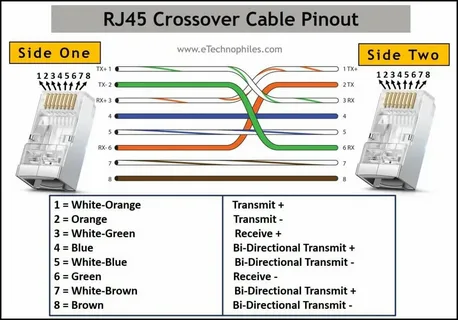
Crossover cables, on the other hand, use T568A on one end and T568B on the other. This swaps the transmit and receive lines, allowing direct communication between similar devices like two computers or two switches without a router.
Although modern networking devices often support auto MDI-X (automatic crossover detection), understanding crossover wiring is still useful for troubleshooting older systems or specialized network setups.
Common Mistakes and Troubleshooting Tips
One of the most common mistakes in Ethernet wiring is failing to maintain the correct wire order before crimping. Even a single misplaced wire can result in a non-functional cable. This is why carefully following the RJ45 connector wiring color sequence explained is so important.
Another frequent issue is not fully inserting the wires into the connector. If the copper does not reach the metal pins, the signal will not transmit properly. Always double-check alignment before crimping.
Poor cable stripping can also damage the internal wires, leading to weak or unstable connections. It is important to strip only the outer jacket and avoid cutting into the twisted pairs themselves.
If a cable is not working, testing it with a cable tester can quickly identify wiring faults. Re-crimping the connector is often the simplest solution if errors are found.
Conclusion
Understanding Ethernet wiring is a valuable skill for anyone working with networks. The RJ45 connector wiring color sequence explained in this article shows that proper cable termination is not complicated, but it does require attention to detail and adherence to standards.
By mastering T568A and T568B layouts, following correct wiring procedures, and avoiding common mistakes, you can build reliable network cables for any environment. Whether for home use or professional installations, accurate RJ45 wiring ensures stable and efficient data communication every time.